Global Trade Agreements: Impact on Mexico’s Economy in 2026
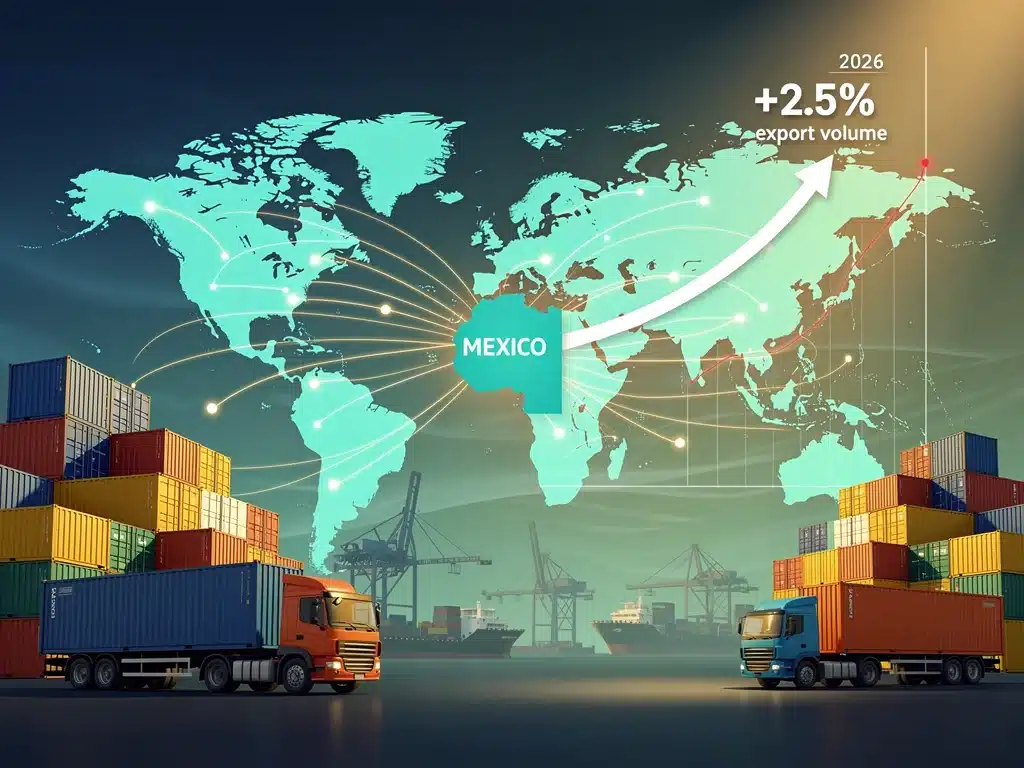
The impact of global trade agreements on Mexico’s economy in 2026 remains significant, but an official 2.5% boost to export volumes cannot be confirmed from current government data.
Mexico’s exports remain strong, while USMCA negotiations, European trade ties and CPTPP expansion continue reshaping its global trade outlook.
The Impact of Global Trade Agreements on Mexico’s Economy in 2026 remains an important economic story as the country navigates record trade flows, changing tariff conditions and the first joint review of the USMCA.
Mexico continues to benefit from extensive access to international markets through a network of 14 free trade agreements covering 52 countries, alongside investment agreements and participation in major multilateral economic forums.
Advertisements
However, the frequently cited claim of a specific 2.5% increase in export volumes should not be presented as an official confirmed 2026 forecast without a verifiable source, making current trade data a more reliable benchmark.
Unpacking Mexico’s Export Performance in 2026
Mexico’s merchandise exports remain historically strong in 2026, reinforcing the country’s importance within North American manufacturing and the broader global trade system despite continuing uncertainty surrounding tariffs and regional trade rules.
Banco de México data show total merchandise exports reaching approximately $81.42 billion in July 2026, following $72.52 billion in June, although monthly figures can fluctuate significantly and should not be interpreted as a guaranteed annual growth trend.
Rather than attributing current performance to one projected 2.5% increase, the more accurate picture combines strong U.S. demand, manufacturing integration, trade agreements, currency movements and changing global supply-chain strategies.
Key Drivers of Mexico’s Export Activity
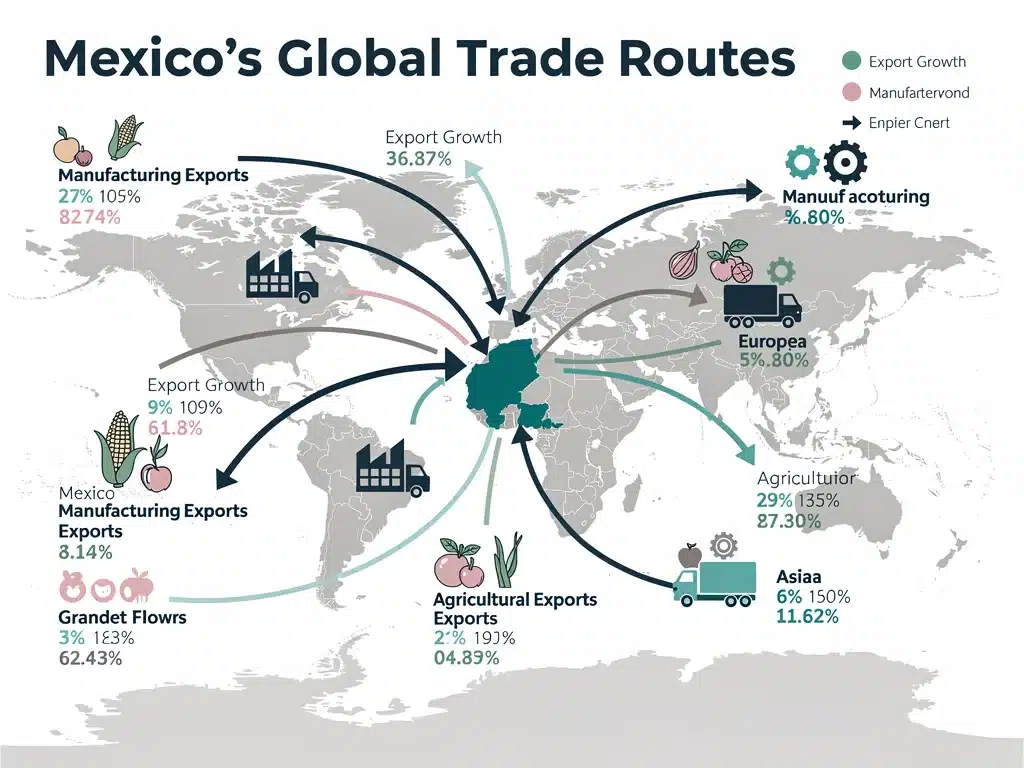
Several factors are supporting Mexico’s export position, including preferential access to major markets, integrated North American production chains and continuing infrastructure development related to transportation, logistics and customs operations.
The USMCA remains particularly important because the United States continues to absorb the large majority of Mexican exports, while trade with Europe and Asia provides additional opportunities for diversification.
Domestic manufacturing capacity, customs efficiency, energy availability, logistics costs and investment conditions also influence whether Mexico can convert its extensive global trade network into sustainable export growth.
USMCA’s Enduring Influence on Trade
The USMCA remains the central framework governing Mexico’s commercial relationship with the United States and Canada, covering areas including rules of origin, labor, digital trade and dispute-resolution procedures.
In 2026, however, the agreement is undergoing its first joint review, with U.S. and Mexican negotiators discussing automobiles, steel, aluminum, agriculture, economic security, labor issues and tighter regional rules of origin.
That review creates both opportunity and uncertainty for manufacturers considering foreign direct investment, because future regional requirements may affect sourcing strategies, eligibility for preferential treatment and long-term production decisions.
Emerging Markets and Diversification Strategies
Mexico’s global trade strategy extends well beyond North America through agreements connecting the country with Latin America, Europe and the Asia-Pacific region.
Mexico and the European Union signed their Modernized Global Agreement and an Interim Trade Agreement in May 2026, creating an updated framework intended to expand bilateral trade and investment opportunities.
Mexico also completed the process allowing the United Kingdom’s CPTPP accession to take effect bilaterally in June 2026, expanding the practical reach of the Pacific trade framework.
Sector-Specific Growth and Export Opportunities
Mexico’s export economy is heavily concentrated in manufactured goods, making industrial production particularly important when evaluating how global trade agreements influence the country.
Automotive products, electronics, machinery and other manufactured goods benefit from established production networks linking Mexican plants with suppliers and customers throughout North America.
Agricultural exports also remain important, although performance varies by product, weather conditions, sanitary requirements, tariffs and changing demand in destination markets.
Automotive Industry at the Forefront
Mexico’s automotive industry remains deeply integrated with production networks in the United States and Canada, with vehicles and components frequently crossing borders during different stages of manufacturing.
USMCA rules of origin determine whether qualifying vehicles receive preferential regional treatment, making those provisions especially important to manufacturers, suppliers and investment decisions.
The 2026 review could modify or strengthen regional-content requirements, meaning the future global trade competitiveness of Mexican automotive production will depend partly on the outcome of current negotiations.
Technological Advancements and Electronics Exports
Mexico has developed major electronics and advanced-manufacturing clusters in states including Jalisco, Baja California, Chihuahua and Nuevo León, supported by proximity to U.S. customers and established supplier networks.
Demand for computing equipment, electronic components and data-center-related hardware can create opportunities, but technological cycles and international competition make future export growth difficult to guarantee.
Supply-chain diversification continues to encourage some companies to consider Mexican production, although energy infrastructure, skilled labor, logistics and policy certainty remain important factors affecting investment decisions.
Challenges and Mitigating Factors for Export Growth
Strong exports do not eliminate risks to Mexico’s global trade outlook, particularly as U.S. trade policy, currency movements and geopolitical tensions continue changing business conditions.
The outcome of the USMCA review could affect regional sourcing requirements, while sector-specific trade disputes involving automobiles, steel, aluminum and agriculture may influence individual exporters differently.
Infrastructure limitations, security concerns, energy availability and border congestion can also reduce the advantages created by geographic proximity and preferential market access.
Global Economic Headwinds and Volatility
Mexican exporters remain exposed to economic conditions in the United States because that market accounts for the majority of Mexico’s merchandise exports and remains central to industrial demand.
A slowdown in U.S. consumption or manufacturing could therefore reduce Mexican export demand, while inflation, interest rates and geopolitical disruptions can affect both costs and investment.
Currency movements matter as well, because a stronger peso can reduce the peso value of dollar-denominated export revenue and pressure margins for some companies even when export volumes remain strong.
Infrastructure and Logistics Enhancements
Transportation capacity remains essential because manufactured exports depend on reliable roads, railways, ports, airports and border crossings connecting production centers with international customers.
Mexico has continued modernizing customs procedures, including upgrades to its single-window system and expansion of customs-broker agency operations across Mexican ports during 2026.
These improvements can facilitate global trade, but exporters still face logistical challenges involving congestion, processing times, security and transportation infrastructure that vary considerably by region.
Government Policies and the 2026 Trade Outlook
Mexico’s trade policy in 2026 combines defending preferential North American access with expanding commercial relationships through Europe, the CPTPP and other existing agreements.
The government is also attempting to strengthen domestic production and attract investment that can increase the amount of value created inside Mexico rather than relying primarily on imported components.
The outcome will depend on implementation, investment conditions and external demand, so government policy should not be described as guaranteeing a particular increase in export volumes.
Trade Promotion and Investment Attraction
Mexico’s extensive treaty network gives companies based in the country preferential access to numerous markets, making trade agreements one factor considered by international manufacturers evaluating new investments.
Strategic location near the United States, established industrial clusters and relatively mature supplier networks can complement these agreements and support export-oriented investment.
Companies still evaluate electricity, water, transportation, regulatory certainty, security and labor availability, meaning trade agreements alone cannot determine whether an investment project succeeds.
Sustainable Trade Practices and ESG Integration
Environmental and labor provisions are increasingly embedded in modern global trade agreements, including the USMCA and the modernized commercial framework between Mexico and the European Union.
Companies exporting internationally can face requirements related to labor rights, environmental compliance, supply-chain traceability and product standards depending on the market and sector involved.
Compliance can preserve market access and reduce trade disputes, but sustainable practices should not be presented as automatically generating higher exports or improved profitability.
Regional Economic Integration and Nearshoring Trends
Nearshoring remains an important theme in Mexico because companies seeking shorter North American supply chains can consider locating production closer to U.S. customers.
Mexico’s proximity, manufacturing experience and USMCA access can support that strategy, particularly for industries where delivery times and regional sourcing are important.
However, nearshoring is not itself proof of a predetermined export increase, and investment outcomes depend on infrastructure, policy stability, energy, workforce availability and company-specific decisions.
Benefits of Nearshoring for Mexican Exports
When new manufacturing capacity is actually established in Mexico, it can increase production, employment and eventually exports if those facilities successfully serve customers in international markets.
Shorter transportation distances to the United States can reduce some logistics risks and allow manufacturers to respond more quickly than supply chains dependent on distant production locations.
The potential advantage is therefore real, but Mexico Global Trade Impact depends on completed investment and operating capacity rather than announcements or nearshoring interest alone.
Strengthening Cross-Border Supply Chains
Mexican, U.S. and Canadian manufacturers frequently participate in integrated production networks in which parts and intermediate goods move across borders before final assembly.
USMCA rules can encourage regional sourcing when companies need qualifying products to satisfy applicable origin requirements and receive preferential treatment.
The 2026 negotiations are particularly important because changes to these requirements could influence which suppliers participate in future North American production networks.
Impact on Mexico’s Labor Market and Human Capital
Export-oriented investment can create employment, but the effect varies according to industry, location, automation level and whether new projects actually move from announcement into operation.
Advanced manufacturing can increase demand for engineers, technicians, logistics professionals and specialized production workers, creating pressure for additional vocational and technical training.
Trade expansion does not automatically improve wages or working conditions for every worker, making labor-market outcomes an important part of evaluating global trade policy.
Job Creation and Skill Development
New factories and expanded export capacity can generate direct manufacturing jobs while also supporting employment among logistics providers, suppliers, maintenance firms and other service businesses.
Technical education becomes increasingly important as automotive, aerospace, electronics and other manufacturers introduce automation, advanced equipment and more sophisticated production systems.
Training partnerships between companies, technical institutions and local governments can help address skill shortages, although the availability and quality of these programs differ across Mexico.
Wages and Living Standards
Higher demand for specialized workers can create wage pressure in industrial regions where multiple employers compete for technicians, engineers and experienced manufacturing personnel.
However, wage improvements are not guaranteed across the entire economy because labor conditions differ widely among industries, occupations and Mexican states.
A more complete assessment of Mexico Global Trade Impact therefore considers wages, productivity, formal employment and regional development alongside headline export values.
Future Trends and Long-Term Trade Projections
Mexico’s longer-term global trade outlook will depend substantially on how the USMCA review concludes and whether North American production integration continues deepening.
Expansion of trade relations with Europe and CPTPP partners provides additional diversification options, although the United States is likely to remain Mexico’s dominant export destination.
Technology adoption, logistics, energy capacity, currency movements and geopolitical conditions will also shape Mexico’s ability to translate market access into competitive exports.
Digitalization and E-commerce in Exports
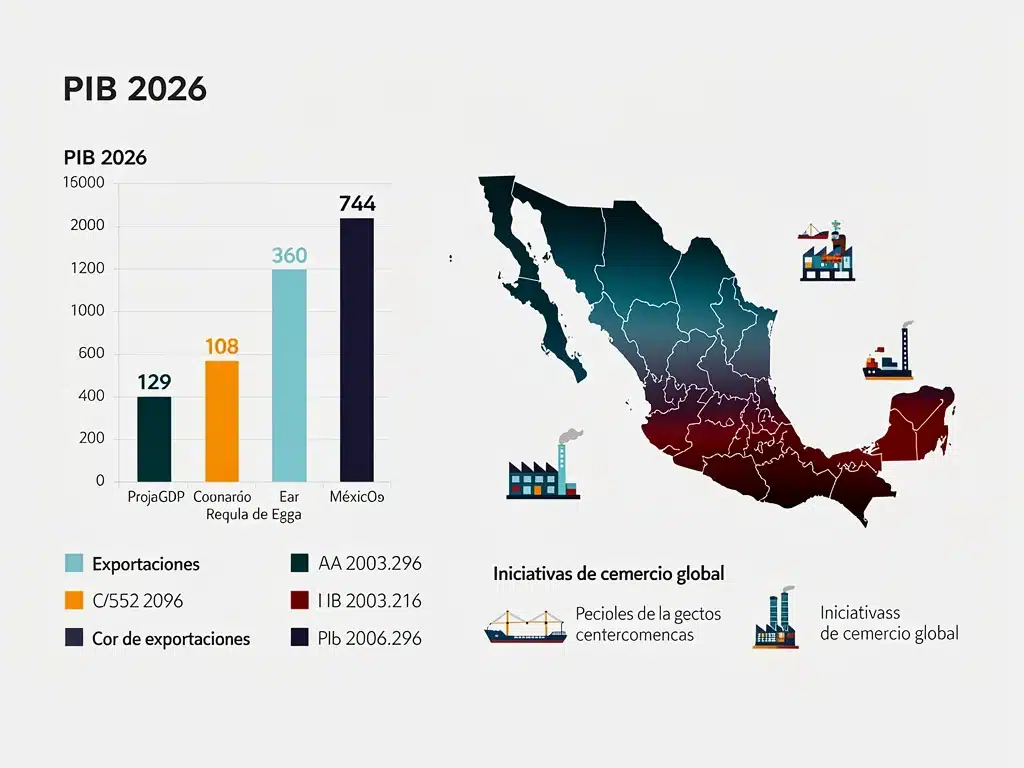
Digital customs systems and electronic documentation can reduce administrative friction when businesses move goods internationally, particularly when processes are integrated across agencies and border operations.
E-commerce can also provide some Mexican small and medium-sized enterprises with additional channels to reach foreign customers without relying exclusively on traditional physical distribution networks.
Digital access does not remove customs, tax, logistics or product-compliance requirements, so businesses still need operational capacity before international online demand becomes sustainable export revenue.
Geopolitical Shifts and Trade Alliances
Geopolitical competition is increasingly influencing global trade, particularly as governments seek greater control over critical supply chains, industrial inputs and strategic technologies.
The 2026 USMCA discussions have explicitly addressed economic security and dependence on non-regional inputs, demonstrating how trade policy is becoming connected with broader strategic objectives.
Mexico’s challenge is to preserve its North American advantages while maintaining useful commercial relationships with Europe, Asia and other partners without assuming diversification can quickly replace U.S. demand.
| Key Point | 2026 Trade Context |
|---|---|
| Export Performance | Mexico recorded approximately $81.42 billion in merchandise exports in July 2026; an official fixed 2.5% annual volume boost has not been confirmed. |
| USMCA Review | 2026 negotiations cover rules of origin, automotive trade, steel, aluminum, agriculture, labor and economic security. |
| Global Trade Network | Mexico maintains 14 free trade agreements covering 52 countries and strengthened EU and CPTPP relationships during 2026. |
| Main Risks | USMCA uncertainty, currency appreciation, infrastructure constraints, tariffs and weaker external demand can affect future export performance. |
Frequently Asked Questions on Mexico’s Trade Outlook
No verified official source currently supports presenting a fixed 2.5% export-volume increase as an established 2026 outcome. Current official merchandise-trade data provide a more reliable measure of Mexico’s export performance.
The USMCA remains particularly important because the United States is Mexico’s dominant export market and North American manufacturing supply chains are highly integrated.
The agreement is undergoing its first joint review. Negotiations have addressed rules of origin, automobiles, steel, aluminum, agriculture, labor, electronic payments and economic security.
Nearshoring can support export capacity when companies establish or expand production in Mexico to serve North American customers, but investment announcements do not automatically translate into higher exports.
Manufacturing dominates Mexico’s exports, with automotive products, electronics, machinery and related industrial goods particularly important. Agriculture and food products also contribute to international trade.
What This Means for Mexico’s Economic Future
Mexico enters the remainder of 2026 with strong merchandise exports and an extensive global trade network, but the outlook is more complex than a guaranteed 2.5% increase in export volumes.
The USMCA review, modernization of EU relations, CPTPP expansion and North American supply-chain investment create opportunities while simultaneously introducing uncertainty over future rules, tariffs and sourcing requirements.
Mexico’s long-term Mexico Global Trade Impact will ultimately depend on productivity, infrastructure, investment, labor skills and the country’s ability to preserve preferential access while adapting to a changing international trade environment.