Foreign Direct Investment in Mexico: Tracking $35 Billion Inflows and Sectoral Shifts in 2026
Advertisements
Are you tracking how global supply chains are being rewritten this year? Foreign Direct Investment in Mexico has taken center stage as the country captures an impressive $35 billion in international capital, driven by an unprecedented nearshoring boom.
This massive injection of cross-border capital is triggerring a profound transformation across the local market.
While traditional automotive manufacturing remains robust, a massive wave of funding is rapidly moving into advanced electronics, artificial intelligence data centers, and specialized financial services.
Staying ahead of these macroeconomic shifts is essential for navigating the North American trade landscape. Let’s dive into the verified data, map out the strategic industries attracting these funds, and pinpoint the exact metrics you need to watch next.
Mexico’s FDI Landscape: A $35 Billion Projection for 2026
Mexico is poised to attract a remarkable $35 billion in Foreign Direct Investment (FDI) by 2026, according to recent projections from the Ministry of Economy.
This anticipated influx underscores the nation’s growing appeal as a global manufacturing and logistics hub, driven by nearshoring trends and strategic trade agreements.
The projected figure represents a significant increase, reflecting confidence from international investors in Mexico’s economic stability and potential for sustained growth.
This capital injection is expected to fuel expansion across various key sectors, creating jobs and fostering technological advancements.
Analysts are closely monitoring these trends, noting that the country’s strategic location and competitive labor force continue to be major draws for foreign capital.
The government’s initiatives to streamline investment processes also play a crucial role in enhancing Mexico’s attractiveness.
Understanding the Drivers Behind Mexico’s FDI Boom
Several factors are converging to propel the surge in Foreign Direct Investment in Mexico. The ongoing trend of nearshoring, where companies relocate production closer to their primary markets, particularly the United States, stands out as a primary catalyst.
Geopolitical shifts and disruptions in global supply chains have also accelerated this movement, positioning Mexico as an ideal alternative for manufacturing and logistics operations.
Companies are seeking greater resilience and efficiency, finding both in Mexico’s industrial corridors.
Furthermore, Mexico’s robust trade agreements, including the USMCA, provide a stable and predictable framework for international businesses.
These agreements reduce trade barriers and offer preferential access to major consumer markets, enhancing the profitability of investments made in the country.
Nearshoring: A Game-Changer for Mexican Investment
The nearshoring phenomenon is fundamentally reshaping the landscape of Foreign Direct Investment in Mexico.
Companies, particularly from North America and Asia, are increasingly choosing Mexico as a strategic location to mitigate risks associated with distant supply chains and rising transportation costs.
This strategic relocation not only brings capital but also advanced technologies and management practices, fostering innovation within local industries.
The government is actively promoting policies to capitalize on this trend, offering incentives and improving infrastructure to support new entrants.
- Increased demand for industrial real estate in northern and central Mexico.
- Expansion of logistics and transportation networks to support cross-border trade.
- Growth in specialized manufacturing sectors, including automotive and electronics.
Key Sectoral Shifts: Where the $35 Billion Will Flow
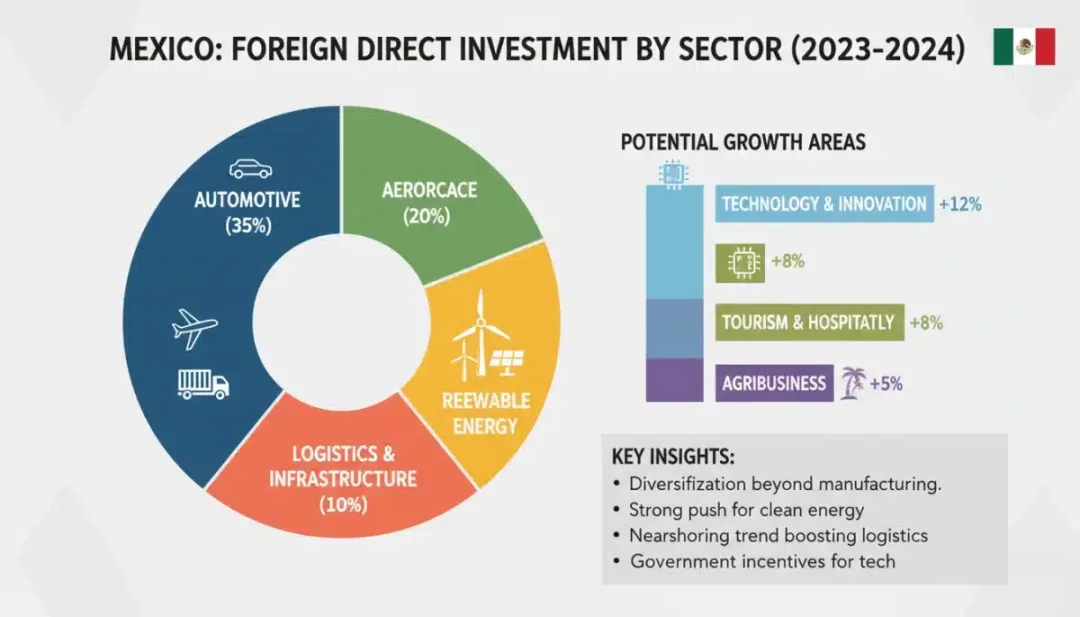
The anticipated $35 billion in Foreign Direct Investment is not uniformly distributed; instead, it is concentrating in specific sectors poised for significant growth and transformation. Manufacturing, particularly the automotive and electronics industries, remains a dominant recipient.
However, emerging sectors such as renewable energy, information technology, and advanced logistics are also attracting substantial capital.
Mexico’s commitment to clean energy and digital transformation is opening new avenues for foreign investors seeking sustainable and high-growth opportunities.
These sectoral shifts indicate a maturation of Mexico’s economy, moving beyond traditional industries to embrace more sophisticated and high-value-added activities. This diversification strengthens the country’s economic resilience and global competitiveness.
Automotive and Electronics: Continued Dominance
The automotive and electronics sectors have historically been pillars of Foreign Direct Investment in Mexico, and this trend is expected to continue through 2026.
Major global players are expanding existing facilities and establishing new plants, driven by proximity to the U.S. market and a skilled labor force.
Investments in these sectors are not just about assembly lines; they include sophisticated R&D centers and advanced manufacturing processes.
This elevates Mexico’s position in the global value chain, moving towards higher-tech production and innovation.
- Expansion of electric vehicle (EV) production and component manufacturing.
- Increased investment in semiconductor and microchip fabrication.
- Development of autonomous driving technologies and smart manufacturing solutions.
The Rise of Renewable Energy and Technology Investments
Beyond traditional manufacturing, the renewable energy and technology sectors are experiencing a significant uptick in Foreign Direct Investment in Mexico.
The country’s abundant solar and wind resources, coupled with government incentives, are attracting substantial capital into sustainable projects.
The digital economy is also a magnet for foreign capital, with investments flowing into software development, IT services, and data centers. Mexico’s growing pool of tech talent and its strategic geographical position make it an attractive location for regional technology hubs.
These emerging sectors represent a strategic diversification for Mexico’s economy, reducing its reliance on traditional industries and fostering a more innovation-driven growth model.
The long-term implications include a more resilient and environmentally conscious economic framework.
Logistics and Infrastructure: Facilitating FDI Growth
Investments in logistics and infrastructure are critical enablers for the overall growth of Foreign Direct Investment in Mexico.
Enhanced connectivity, modern ports, and efficient transportation networks are essential for supporting the influx of manufacturing and trade activities driven by nearshoring.
Both public and private sectors are channeling significant resources into upgrading existing infrastructure and developing new projects.
This includes expanding highways, improving rail lines, and modernizing port facilities to handle increased cargo volumes and streamline supply chains.
- Development of multimodal logistics parks near major industrial centers.
- Investment in digital infrastructure to support e-commerce and data-driven operations.
- Upgrades to border crossing facilities to expedite trade flows with the U.S.
Regional Impact and Development Hotspots
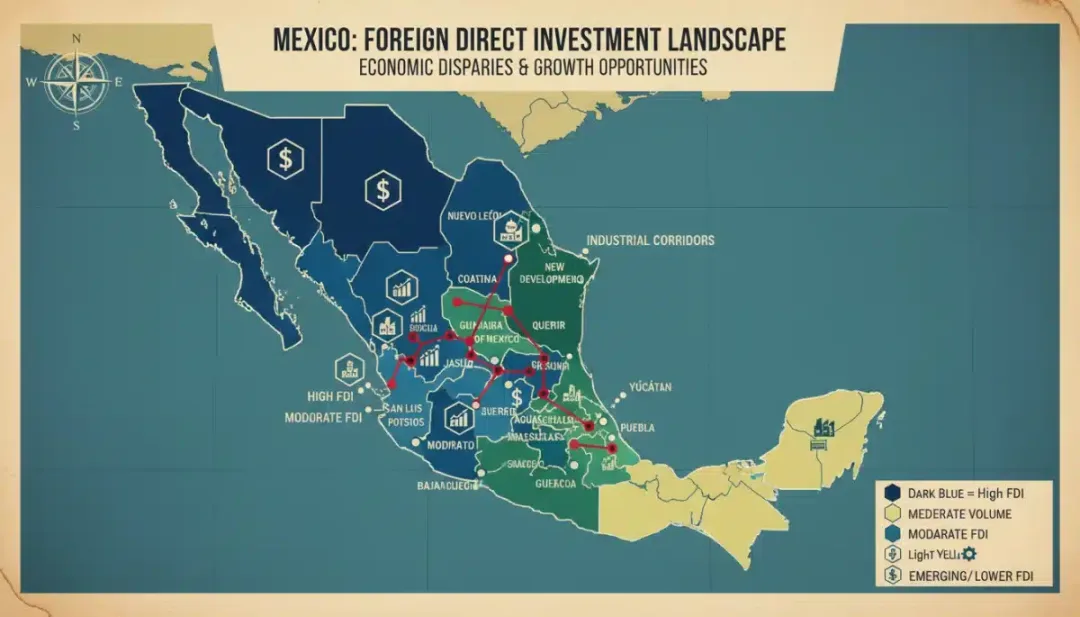
The impact of Foreign Direct Investment in Mexico is not evenly distributed across the country; certain regions are emerging as key hotspots for investment due to their strategic advantages and existing industrial ecosystems.
The northern states, bordering the U.S., continue to be prime destinations.
States like Nuevo León, Coahuila, and Baja California are witnessing substantial investment in automotive, electronics, and aerospace industries. Their proximity to the U.S. market and established supply chains make them highly attractive for nearshoring initiatives.
Central Mexico, particularly the Bajío region, also remains a strong magnet for FDI, especially in automotive and advanced manufacturing. The development of new industrial parks and skilled labor availability contribute significantly to its appeal.
Government Policies and Investment Climate
The Mexican government plays a pivotal role in shaping the investment climate and attracting Foreign Direct Investment in Mexico.
Policies aimed at regulatory simplification, tax incentives, and infrastructure development are crucial for maintaining investor confidence and competitiveness.
Efforts to combat corruption and enhance legal certainty are also vital for creating a predictable and secure environment for foreign capital. The administration’s focus on specific industrial corridors and strategic projects further guides investment flows.
Dialogue between the government and the private sector is essential for identifying and addressing challenges, ensuring that Mexico remains a top destination for international investors. Continuous adaptation of policies to global economic trends is also paramount.
Challenges and Opportunities for Sustained FDI Growth
While the outlook for Foreign Direct Investment in Mexico is largely positive, several challenges need to be addressed to ensure sustained growth.
These include infrastructure bottlenecks, skilled labor shortages in certain specialized fields, and the need for continued regulatory improvements.
Opportunities, however, abound. Mexico can further capitalize on its geographical advantages, diversify its export base, and deepen its integration into global value chains.
Investing in education and workforce development will be critical to meet the demands of advanced industries.
The ability to adapt to technological advancements and embrace sustainable practices will define Mexico’s long-term success in attracting and retaining FDI. Strategic planning and proactive policy-making are essential to navigate the evolving global economic landscape.
| Key Point | Brief Description |
|---|---|
| 2026 FDI Projection | Mexico anticipates $35 billion in Foreign Direct Investment by 2026. |
| Key Drivers | Nearshoring, trade agreements, and geopolitical shifts fuel investment. |
| Sectoral Focus | Manufacturing, renewable energy, and technology attracting major capital. |
| Regional Hotspots | Northern states and the Bajío region lead in attracting FDI. |
Frequently Asked Questions About Mexico FDI 2026
What is the projected Foreign Direct Investment in Mexico for 2026?▼Mexico is projected to attract $35 billion in Foreign Direct Investment by 2026. This forecast reflects strong investor confidence and strategic economic positioning, indicating a robust outlook for capital inflows across various sectors.
Which sectors are primarily benefiting from this FDI?▼The primary beneficiaries are manufacturing, particularly automotive and electronics, alongside emerging sectors like renewable energy, information technology, and logistics. These industries are experiencing significant expansion and modernization thanks to foreign capital.
How does nearshoring influence Foreign Direct Investment in Mexico?▼Nearshoring is a major driver, as companies relocate production closer to North American markets to enhance supply chain resilience and reduce costs. This trend significantly boosts Foreign Direct Investment in Mexico, especially in border regions and industrial corridors.
What role do government policies play in attracting FDI?▼Government policies, including regulatory simplification, tax incentives, and infrastructure development, are crucial. These measures create a favorable investment climate, ensuring legal certainty and supporting the operational needs of foreign enterprises in Mexico.
What are the main challenges for sustained FDI growth in Mexico?▼Key challenges include infrastructure bottlenecks, skilled labor shortages, and the need for ongoing regulatory improvements. Addressing these issues is vital for Mexico to maintain its competitive edge and sustain high levels of Foreign Direct Investment in the long term.
Looking Ahead: Implications for Mexico’s Economic Future
The projected $35 billion in Foreign Direct Investment in Mexico by 2026 signals a transformative period for the nation’s economy.
This capital influx is not merely a financial statistic; it represents a commitment to Mexico’s industrial capacity, technological advancement, and human capital development.
The ongoing shifts towards higher-value sectors and the strategic embrace of nearshoring will undoubtedly redefine Mexico’s position in the global economy.
Continuous monitoring of policy implementation, infrastructure development, and workforce training will be crucial to fully capitalize on these opportunities and ensure sustainable growth for Foreign Direct Investment in Mexico.