Mexico’s Digital Economy: 12% E-commerce Growth by 2026
Advertisements
Mexico’s digital economy in 2026 is building on a strong expansion in online retail, with e-commerce reaching MXN 941 billion in 2025, 77.2 million digital buyers and continued growth in mobile commerce, marketplaces, digital payments and artificial intelligence.
Mexico’s digital economy in 2026 is entering a more mature stage as online shopping becomes increasingly integrated into everyday consumer behavior and businesses compete across marketplaces, proprietary stores, social commerce and mobile channels.
The latest consolidated data from the Mexican Online Sales Association (AMVO) shows that online retail reached MXN 941 billion in 2025, growing 19.2% compared with the previous year and providing a much stronger factual benchmark than an unsupported 12% projection.
Rather than asking whether Mexican e-commerce will simply grow in 2026, the more important question is how businesses will capture additional value from a market that already includes tens of millions of active digital shoppers.
Mexico’s E-commerce Market Enters a More Mature Phase
Mexico’s online retail market reached approximately MXN 941 billion in 2025, representing 19.2% annual growth and confirming the continued expansion of digital commerce within the country’s broader retail economy.
AMVO also reports 77.2 million active digital economy buyers, demonstrating that e-commerce is no longer a niche channel but a mainstream part of how Mexican consumers research and purchase products.
This scale changes the competitive challenge in 2026 because future growth increasingly depends on improving conversion, loyalty, logistics and customer experience rather than simply convincing consumers to try online shopping for the first time.
Why the 12% Growth Projection Should Be Treated Carefully

The original claim that Mexican e-commerce was specifically projected to grow 12% in 2026 does not align with the strongest current market data available from AMVO and should not be presented as a verified forecast without a clearly identifiable source.
AMVO’s 2026 study instead reports actual 2025 retail e-commerce growth of 19.2%, providing a documented baseline from which businesses can evaluate performance during the current year.
Forecasts can still be useful for planning, but they should be distinguished from confirmed historical results so readers understand whether a percentage represents measured growth or an estimate of future activity.
What Is Driving Mexico’s Digital Economy in 2026
Mexico’s continued e-commerce expansion reflects several interconnected forces, including widespread internet use, mobile shopping, digital payment adoption, marketplace penetration and greater familiarity with online purchasing.
AMVO reports that 88.2% of Mexican internet users already purchase online, suggesting that the next stage of growth will depend heavily on increasing purchase frequency and improving customer retention.
Businesses therefore need to focus on how easily consumers can discover products, compare options, complete payments, receive orders and obtain support after the transaction.
Mobile Commerce Has Become Essential
Smartphones play a central role in the Mexican digital economy shopping journey because consumers use mobile devices to research products, compare prices, interact with brands and complete purchases.
During HOT SALE 2025, mobile devices accounted for approximately 74% of traffic, illustrating how strongly major Mexican e-commerce events already depend on mobile-first consumer behavior.
For retailers, this means that slow pages, complicated checkout processes or poor mobile navigation can directly reduce conversion even when demand for the product itself is strong.
- Design product pages primarily for mobile users.
- Reduce unnecessary steps during checkout.
- Optimize page speed and payment flows.
- Make shipping and return information easy to find.
Digital Payments Continue to Reduce Purchase Friction
The development of digital economy payments has made online commerce more accessible by allowing consumers to choose among cards, transfers, wallets and other payment methods depending on the merchant and platform.
This flexibility matters in Mexico because consumers have different levels of access to traditional banking and may prefer different payment methods according to trust, convenience and purchase value.
Retailers that support secure and familiar payment options can reduce checkout abandonment while expanding their potential customer base beyond shoppers who rely exclusively on conventional credit cards.
Marketplaces Dominate a Large Share of Online Commerce
Marketplaces remain extremely influential in Mexico because they combine large audiences, extensive product catalogs, payment infrastructure, reviews and established logistics within a single shopping environment.
AMVO’s 2026 market analysis indicates that Mercado Libre, Amazon Mexico and Shein together account for more than 60% of Mexico’s B2C e-commerce gross merchandise value.
This concentration creates both opportunity and dependency, pushing brands to decide how much of their sales should come from marketplaces and how much should be developed through proprietary channels.
Marketplace or Independent Online Store?
A marketplace can provide immediate access to traffic and consumer trust, making it useful for product discovery and for businesses that do not yet have a large audience of their own.
An independent store gives businesses greater control over branding, customer data, merchandising and long-term relationships, although acquiring traffic can require significantly more marketing investment.
For many Mexican retailers in 2026, a hybrid strategy can therefore be more practical than choosing only one channel, with marketplaces supporting discovery and proprietary stores supporting loyalty and margin.
Mexico’s Digital Consumers Are Becoming More Experienced
The Mexican online shopper in 2026 is increasingly experienced, comparing sellers, researching products, reviewing delivery conditions and evaluating promotions before completing a purchase.
AMVO’s data around major shopping events shows that consumers often begin researching products weeks before promotional campaigns officially begin, indicating more deliberate purchasing behavior.
This maturity means retailers cannot depend solely on discounts and must compete through product information, customer service, reliable delivery and a consistent overall shopping experience.
Convenience Is No Longer Enough
Convenience remains an important reason to shop online, but experienced consumers increasingly expect competitive prices, transparent delivery dates, reliable inventory information and simple returns.
A poor delivery or customer service experience can quickly offset the convenience of buying online, especially when shoppers can switch between competing platforms with minimal effort.
Retailers therefore need to view logistics, support and post-purchase communication as part of the product experience rather than secondary operational functions.
Logistics Remains One of Mexico’s Biggest E-commerce Challenges
As online sales increase, logistics becomes more important because consumers expect orders to arrive reliably across a country with significant differences in geography, infrastructure and population density.
Delivery in major metropolitan areas can operate very differently from fulfillment in smaller cities or remote locations, creating challenges involving cost, speed and service consistency.
Businesses are responding with additional fulfillment capacity, regional distribution strategies, pickup options, route optimization and partnerships with specialized delivery providers.
Last-Mile Delivery Can Determine Customer Loyalty
The final stage of delivery is especially important because it is often the only physical interaction a consumer has with an online transaction after completing checkout.
Delays, damaged packages or unclear tracking can reduce trust even when the retailer’s website and product selection are otherwise strong.
Providing accurate delivery estimates and proactive communication can therefore improve satisfaction without requiring every retailer to promise unrealistic same-day or next-day delivery.
- Provide realistic delivery estimates.
- Offer tracking whenever possible.
- Develop procedures for delayed or damaged orders.
- Evaluate fulfillment performance by region.
Mexico’s Online Economy Extends Beyond Retail
The country’s digital economy extends beyond traditional online retail and includes financial services, digital entertainment, education, logistics, software, advertising and other technology-enabled activities.
Growth in one area can reinforce another because more digital payments support e-commerce, stronger logistics supports marketplaces, and improved connectivity expands access to multiple online services.
For businesses evaluating Mexico, this broader ecosystem matters because e-commerce growth is supported by infrastructure and technologies that serve many other parts of the digital economy.
Fintech and Digital Commerce Are Increasingly Connected
Fintech companies support online commerce through payment processing, digital accounts, fraud detection, installment options and other financial services integrated into the purchasing journey.
This connection can help merchants reach consumers who may not use traditional credit products while also simplifying transactions inside marketplaces and independent stores.
However, greater reliance on digital financial infrastructure also increases the importance of cybersecurity, transparent fees and responsible handling of customer information.
Cybersecurity and Consumer Trust Are Strategic Issues
As more transactions move online, cybersecurity becomes a fundamental requirement for maintaining confidence in Mexico’s digital economy rather than merely a technical responsibility for IT departments.
Consumers may encounter phishing, account takeover, fraudulent sellers, counterfeit products and other risks that can undermine trust in online platforms when safeguards are weak.
Merchants and marketplaces can respond through secure payment systems, authentication controls, fraud monitoring and clear processes for resolving disputes and unauthorized transactions.
Building Trust Throughout the Purchase Journey
Trust begins before checkout with clear product information, seller identification, transparent prices and realistic claims about availability and delivery.
During payment, consumers should have access to secure systems and enough information to understand what they are purchasing and which company will process the transaction.
After the sale, accessible customer service and straightforward refund or return procedures reinforce confidence and can determine whether a first-time buyer becomes a repeat customer.
Investment Is Supporting Mexico’s Digital Infrastructure
The growth of digital commerce encourages investment in logistics, cloud infrastructure, data centers, financial technology, retail technology and other services required by an expanding online market.
Mexico’s position as a large consumer market and manufacturing economy also creates opportunities for companies connecting physical supply chains with digital sales channels.
Investors should nevertheless distinguish general foreign direct investment from investment specifically attributable to e-commerce because the two measures describe different parts of the economy.
Why the Investment Map Needs Context
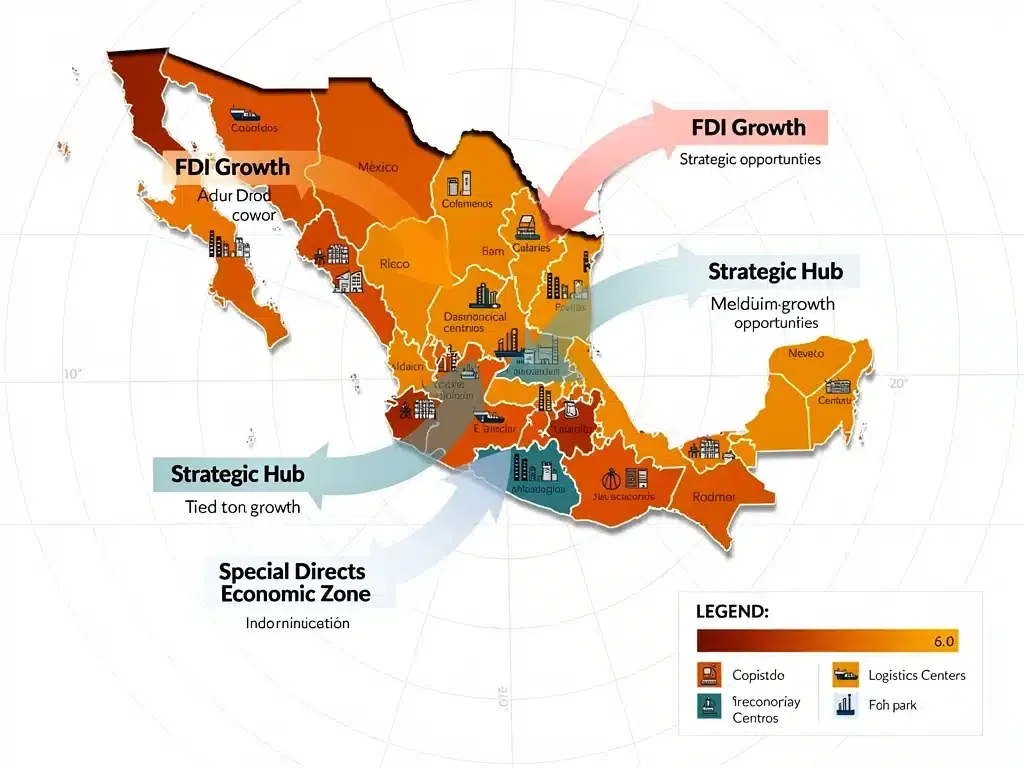
The regional foreign direct investment image included in this article can provide useful economic context, but it should not be interpreted as a direct measure of e-commerce growth across individual Mexican states.
Foreign investment includes manufacturing, infrastructure, services and many other economic activities, meaning stronger investment in one region does not necessarily indicate higher online retail sales there.
It is therefore more accurate to use the image as supporting context for Mexico’s broader investment environment rather than presenting it as direct evidence of digital-commerce performance.
Artificial Intelligence Is Becoming Part of E-commerce Strategy
Artificial intelligence is moving from experimentation into operational use as Mexican retailers adopt tools for product recommendations, customer service, marketing, inventory analysis and demand forecasting.
AMVO has highlighted the emergence of agentic commerce, where AI systems can potentially assist users with product discovery, comparison and certain purchasing activities with less continuous manual interaction.
For businesses, the opportunity is significant, but useful AI adoption will depend on whether the technology improves conversion and service rather than simply adding new features without clear customer value.
From Recommendation Engines to Agentic Commerce
Traditional recommendation systems analyze browsing and purchasing activity to suggest products, while newer AI tools can process more complex requests and help consumers compare larger numbers of alternatives.
Agentic commerce takes this concept further by exploring systems capable of performing multiple shopping-related tasks on behalf of consumers or businesses.
Whether these tools become mainstream will depend on trust, payment security, data permissions and the ability of consumers to understand when an automated system is making decisions on their behalf.
Major Shopping Events Continue to Accelerate Digital Demand
Promotional events such as HOT SALE remain important indicators of Mexico’s digital shopping behavior because they concentrate traffic, transactions and promotional activity into a limited period.
HOT SALE 2025 generated MXN 42.725 billion in total sales, representing growth of 23.7% compared with the previous edition and approximately 19.2 million orders.
These figures demonstrate the scale online commerce can reach during concentrated demand periods while also testing logistics, payment infrastructure and customer service capacity.
What HOT SALE Reveals About Mexican Consumers
AMVO reported that many consumers research purchases well before HOT SALE begins, showing that major promotional events increasingly capture demand that has already been evaluated in advance.
Mobile devices represented approximately 74% of traffic during the 2025 campaign, reinforcing the importance of mobile optimization for brands competing during high-demand periods.
The lesson for retailers is that planning needs to start before the promotional window itself, including inventory, advertising, pricing, fulfillment and customer support preparation.
What Businesses Should Monitor During the Rest of 2026
The Mexican e-commerce market is already large, so companies should monitor not only headline sales growth but also conversion rates, acquisition costs, repeat purchasing and profitability across individual channels.
Marketplace concentration, artificial intelligence adoption, mobile commerce, logistics and consumer trust will remain particularly important when evaluating how competition evolves during the remainder of the year.
Businesses should also track Mexico’s regulatory and economic environment because changes affecting payments, data, consumer protection or trade can influence operating costs and digital-commerce strategies.
Metrics That Matter More Than a Single Growth Forecast
A national growth percentage provides useful context, but individual retailers can still underperform even while the overall e-commerce market expands rapidly.
Businesses should therefore monitor conversion, average order value, customer acquisition cost, repeat purchases, return rates, fulfillment cost and contribution margin to understand their own position.
These operating indicators provide a more actionable picture than relying on an unsupported prediction that the entire market will grow by exactly 12% during 2026.
- Conversion rate.
- Customer acquisition cost.
- Average order value.
- Repeat purchase rate.
- Return and refund rate.
- Fulfillment and delivery costs.
Mexico’s Digital Economy Outlook for 2026 and Beyond
Mexico enters the rest of 2026 with one of the largest and fastest-developing e-commerce ecosystems in Latin America, supported by millions of digital shoppers and a market that expanded strongly in 2025.
AMVO data indicates that Mexico’s e-commerce market multiplied approximately 2.7 times over five years, while the country accounted for roughly 30% of Latin America’s digital commerce value in 2025.
The next stage will depend less on basic adoption and more on whether retailers can improve profitability, loyalty, logistics and technology while responding to increasingly sophisticated consumers.
| Key Point | Current 2026 Context |
|---|---|
| Online Retail Value | Mexico’s online retail market reached approximately MXN 941 billion in 2025. |
| Annual Growth | The latest consolidated AMVO figure shows 19.2% growth in 2025 rather than a verified 12% projection for 2026. |
| Digital Buyers | AMVO reports approximately 77.2 million active digital buyers in Mexico. |
| Next Growth Phase | Conversion, loyalty, logistics, AI and omnichannel execution are becoming increasingly important. |
Frequently Asked Questions About Mexico’s Digital Economy
Is Mexico’s e-commerce market officially projected to grow exactly 12% in 2026?▼The strongest current AMVO data does not establish a verified 12% 2026 growth figure. Its 2026 study reports that Mexican online retail reached MXN 941 billion in 2025, representing annual growth of 19.2%.
How large is Mexico’s online retail market?▼AMVO reports an online retail market value of approximately MXN 941 billion for 2025, with around 77.2 million digital buyers.
What is driving e-commerce growth in Mexico?▼Major drivers include widespread digital shopping adoption, mobile commerce, marketplaces, diverse payment options, improved logistics and growing use of technology such as artificial intelligence.
What are the main challenges for Mexican e-commerce businesses?▼Key challenges include logistics costs, last-mile delivery, cybersecurity, marketplace concentration, customer acquisition costs and the need to maintain trust throughout the purchasing process.
What should businesses monitor during the rest of 2026?▼Businesses should monitor conversion, profitability, repeat purchasing, mobile performance, AI adoption, logistics efficiency and changes in how consumers divide purchases between marketplaces and independent stores.
What Mexico’s Digital economy Growth Means Now
Mexico’s digital economy is no longer defined primarily by whether consumers are willing to shop online, because digital purchasing has already reached broad adoption.
The latest evidence points to a market worth MXN 941 billion in online retail sales in 2025 and 77.2 million digital buyers, giving businesses a strong base for competition in 2026. :contentReference[oaicite:1]{index=1}
The most important question for the remainder of 2026 is therefore not whether e-commerce can grow by one predetermined percentage, but which companies can convert Mexico’s large digital audience into profitable and lasting customer relationships.